
Robotic Lawn Mowers
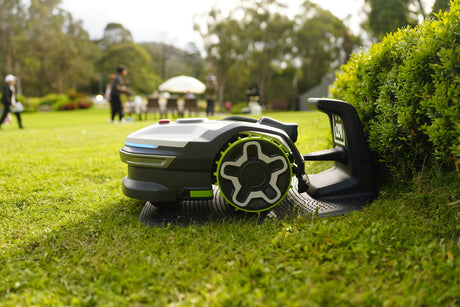
A robotic lawn mower maintains the lawn automatically according to the set programme and returns to its charging station when necessary. The Greenworks collection includes four AiMowbot RTKVision™ models that work without a boundary wire and one Optimow that uses a boundary wire. When choosing, first compare the lawn area associated with each model, the navigation system, cutting width and height, maximum gradient and connectivity options. These differences will help you select the configuration suited to your garden.


Robotic Lawn Mower Buying Guide
Robotic Lawn Mower Buying Guide
How to choose the best robotic lawn mower
The best robotic lawn mower depends primarily on the layout of the lawn and the settings you want to manage. The arrangement of the different zones also matters. Start by identifying the area to maintain, then compare the navigation system, maximum gradient and cutting dimensions. Also look at how the mowing zones are defined and which connections are available. This approach takes the comparison beyond the range name or cutting width alone and helps identify the functions that are genuinely useful for the way your garden is organised.
Robotic lawn mower with or without a boundary wire?
The AiMowbot C6, C8, C10 and C12 use RTKVision™, which combines satellite positioning and 3D vision to navigate without a boundary wire. Mowing zones, no-go zones and routes can be configured in the app. Multiple zones and multiple maps can also be saved.
The Optimow 15 uses a boundary wire and moves in a random pattern. Its guide wire can help it return to the charging station in complex gardens, but remains optional. The choice therefore depends on how you want to define and organise the lawn. The main difference lies in how its boundaries and different zones are defined during installation.
Compare lawn area and cutting dimensions
Within the AiMowbot family, the models cover areas of up to 600 m² for the C6, 800 m² for the C8, 1,000 m² for the C10 and 1,200 m² for the C12. All four models have a cutting width of 20 cm and an adjustable cutting height of 20 to 90 mm.
The Optimow 15 differs with a cutting width of 22 cm and an adjustable cutting height of 20 to 60 mm. When comparing models, consider the cutting width alongside the navigation system, the boundaries of the lawn and the programming functions that matter for your purchase.
Gradients, narrow passages and obstacles
The four AiMowbot models have a maximum gradient of 45%. Their front-wheel drive, three-wheel layout and large front wheels make up their movement system. Their AI vision, combined with 3D ToF sensors, detects and avoids more than 200 types of obstacles. Mapping also allows transport routes and no-go zones to be defined.
The Optimow 15 has a maximum gradient of 35% and a clear passage of 60 cm. It has collision and lift sensors, as well as rain and frost sensors. Compare the stated gradient, specified clear passage and the method used to manage obstacles.
Mobile app and mowing management
The AiMowbot models offer Bluetooth, WLAN and 4G connectivity, with one year of 4G included. The app allows you to track mowing progress, adjust zones and change routes. Settings can also be viewed on the mower’s LCD screen. These models also have LED lights.
The Optimow 15 uses a 2G/4G connection and has a pre-installed SIM card. Its mowing programme can be changed in the Greenworks app, which also allows the mower to be monitored. When comparing models, consider the available connections, the controls accessible on the mower and the functions available remotely.
FAQs
Which robotic lawn mower should I choose for my lawn?
Which robotic lawn mower should I choose for my lawn?
Compare the area of your lawn with the area associated with each model, then consider the gradient, passages and how you want to define the zones. The AiMowbot models use mapping without a boundary wire, while the Optimow 15 uses a wire. Cutting dimensions and connectivity options complete the comparison.
How does a robotic lawn mower without a boundary wire work?
How does a robotic lawn mower without a boundary wire work?
The AiMowbot C6, C8, C10 and C12 combine RTKVision™ satellite positioning with 3D vision. The lawn is organised in the app using mowing zones, no-go zones and routes. The mower then uses a systematic cutting system and automatically returns to its charging station when necessary.
Is a boundary wire necessary for every model?
Is a boundary wire necessary for every model?
No. The four AiMowbot RTKVision™ models move without a boundary wire once the map and zones have been configured in the app. The Optimow 15 instead uses a boundary wire to define the lawn boundaries. Its guide wire remains optional and can help it return to the charging station in complex gardens.
How do the models respond to gradients and obstacles?
How do the models respond to gradients and obstacles?
The AiMowbot models have a maximum gradient of 45% and use AI vision with 3D ToF sensors to detect and avoid more than 200 types of obstacles. The Optimow 15 has a maximum gradient of 35% and uses collision sensors that stop it and make it change direction.
What happens to the grass clippings after mowing?
What happens to the grass clippings after mowing?
The mowers regularly cut small amounts of grass. The fine clippings remain on the lawn and decompose naturally, which Greenworks describes as a natural mulching effect. This approach is based on frequent passes that cut only a small amount at a time. The mower continues maintaining the lawn according to the set mowing programme.